Shellz Training Guard™

Strong leasing is practiced, not presented.

Interactive, workshop-style training for multifamily leasing teams and the managers who lead them.

We get in the room, work the actual conversations, and leave your managers with something they can hold the team to on Monday.

Onsite · 9 AM to 2 PM · Multifamily only · Role-play driven · Nationwide

Where teams usually are

You already know something needs to change. Here is what that usually looks like.

You hired someone in March and nobody ever really trained her.

She learned where the fitness center is. She learned how to open a work order. She figured out the rest by watching whoever was closest. Your manager meant to train her — she genuinely did — but she is running a property, and there is no version of that job with four uninterrupted hours in it for teaching someone how to lease.

So your newest person is doing her best with what she picked up. And what she picked up is whatever the person next to her happens to do.

The numbers came in under where they needed to be.

You had the traffic. You have people who care. Somewhere between the phone ringing and the lease getting signed it stopped converting — and the answer is not more leads, because you already paid for the ones you did not close.

The months ahead are the only stretch of the year when you can take a team off the floor and actually fix something.

You have to explain those numbers to somebody.

Ownership does not want effort. They want to know what is being done and whether it worked. You need something you can point to — a plan, an action, and a result you can put in front of them with a date on it.

Your team has been doing this a long time, and it shows in both directions.

Your veterans are efficient. They are also on autopilot. The tour has gotten shorter, the discovery questions have gotten fewer, and the application ask went away somewhere around year three. Nobody is doing anything wrong. They have just stopped doing some of the things that used to work.

Two of your properties lease two completely different ways.

Same portfolio, same expectations, same budget. One site asks for the application every time. The other waits for the prospect to bring it up. You cannot coach a standard that does not exist yet.

Any of that sound familiar? That is what this is built for.

What we train

Pick what your team needs. Or tell us what you are seeing and we will help you find it.

Lead Response & Phone Leasing

What happens when the phone rings, the internet lead comes in, or a prospect reaches out by text or chat — how fast someone responds, what gets asked, who owns the next step, and whether the conversation ends with a real appointment or with “come by anytime.”

AI-Assisted Leasing & Human Handoff

AI can answer the first question, schedule the appointment, send the reminder, and carry the follow-up all the way to the application. The handoff still has to work. We train teams on when the human takes over, what information carries forward, how to open without re-asking what the prospect already answered, what to do when the system quoted a number that is no longer accurate, and how to answer honestly when someone asks whether they were talking to a person.

Discovery & Needs Analysis

Learning what this person actually needs before you start selling. Where they are coming from, when they have to be out, what is driving the move, what matters most, and what they are afraid of getting wrong.

Centralized & Portfolio Leasing

When one leasing professional is selling more than one community, knowing one property is not enough. We train teams to understand the portfolio, qualify the need once, match the prospect to the right options, explain meaningful differences between communities, coordinate tours and handoffs, and keep ownership of the prospect even when their first choice is not the right fit.

Touring & Presentation

Showing the right apartment to the right person instead of walking the same route in the same order. Reading the prospect. Connecting what you show to what they told you matters. The selling approach changes with the asset — a downtown high-rise, a suburban garden community, a lease-up and a build-to-rent community do not have the same story, tour, or buying triggers. We also cover the tours you were not standing in: how to debrief a self-guided visit you did not witness, and how to hold attention on a live video tour.

Pricing Conversations & Fee Disclosure

What gets quoted, in what order, and what has to be said out loud. In markets where it is required, that can mean total monthly price before you ask for personal information. Which fees are mandatory and which are optional — said unprompted, not when asked. What to do when the website, the CRM and the automated assistant are quoting three different numbers. This is a sales conversation and a compliance conversation at the same time, and we train it as both.

Value, Urgency, Concessions & Objections

Building enough value that price is not the whole conversation. Using concessions without making the concession the entire sales strategy. Handling “it is more than I wanted to spend,” “what specials do you have?” and “we are going to look at a few more places” without folding or discounting automatically.

Closing & Application Conversion

Asking. Every time. Making the ask sound like helping instead of pushing, recognizing buying signals, and never letting a good tour end without a defined next step toward the application. We also train the verification conversation at application — the same questions asked of every applicant, every time, because consistency is what protects the property and the person asking.

Follow-Up, CRM & Lead Management

What you say on the second call and the third one. Following up with a reason instead of checking a box in the CRM. Knowing what automation already sent, what the prospect already knows, who owns the next touch, and how to keep the conversation moving without duplicate or disconnected communication.

Safety on the Leasing Floor

The job puts your team alone with people they have never met, in units nobody can see into, often with one person holding the office. We train the habits that keep that manageable — who knows where you are, how you move through a unit, how you handle a walk-in when you are by yourself, and when the right answer is to reschedule. We train safety and prospect experience together, so protecting the person does not mean abandoning good leasing behavior.

Also availableNew Leasing Professional Development · Advanced Leasing & Conversion Workshops · Manager Coaching & Reinforcement · Lease-Up Team Training · Centralized Leasing Team Development · Multi-Site & Portfolio Team Sessions

The workshop

We get in the trenches with your team.

This is not a motivational morning. Nobody sits in the back with a laptop open.

There is a teaching portion — what good execution looks like, why it works, what it sounds like. How long that runs depends on the room and the group in front of us. Then we drill it.

Your team works the actual conversations. The price objection. The prospect who needs to think about it. The tour that is going great and nobody has asked for anything. The third follow-up call when you have already left two voicemails and you do not know what else to say.

They do it out loud, in front of each other. They get feedback, and then they do it again — because the first attempt is always stiff and the fourth one starts to sound like them.

It is a little uncomfortable. That is the point. The first time somebody has to find the words should not be with a prospect sitting across the desk.

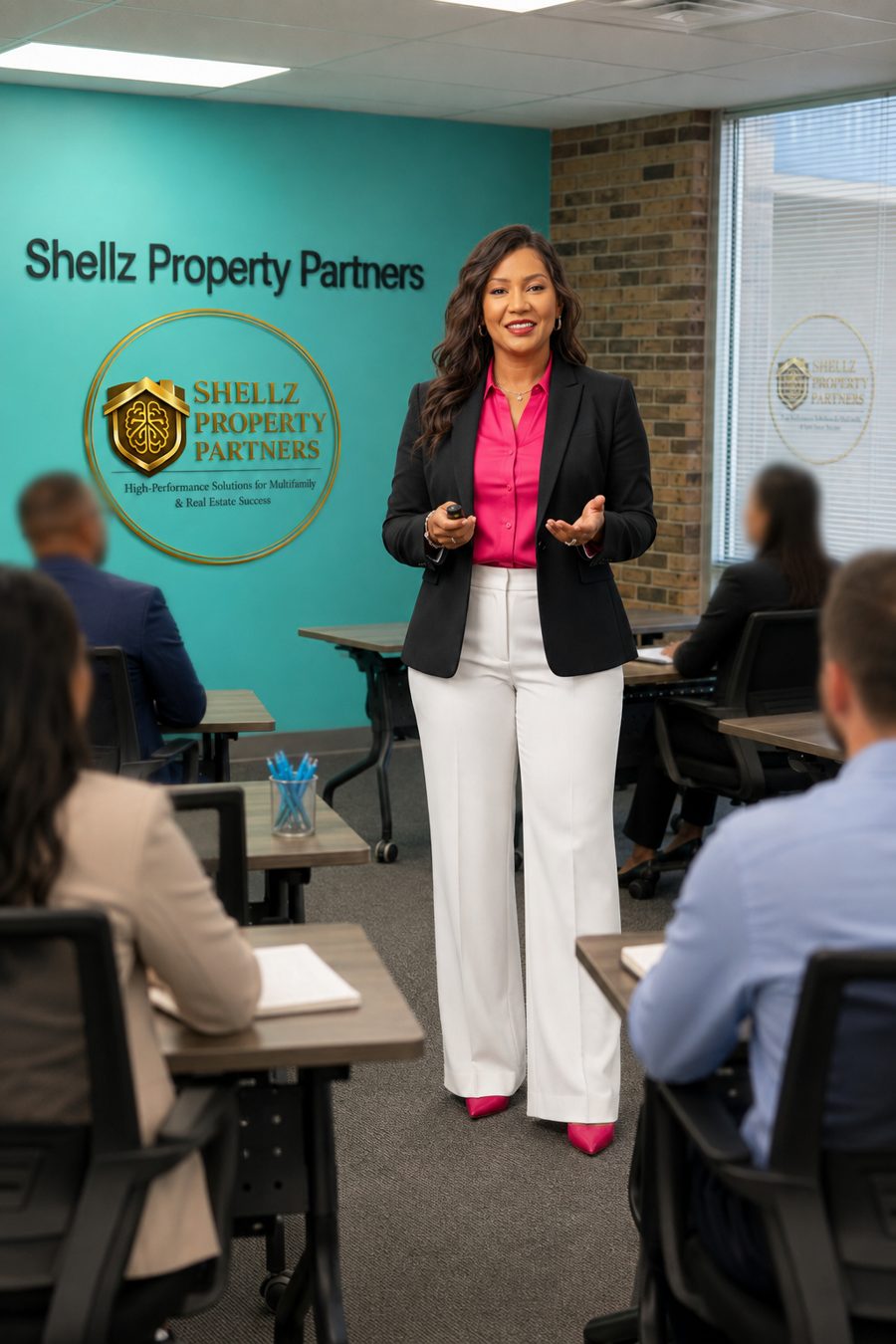
Shelly Gray training a leasing team

What a session involves

  • Live role-play using real scenarios from your market
  • Calls worked and reviewed in the room
  • Scenario drills under interruption and time pressure
  • Peer observation, so agents learn from each other's reps
  • Managers drilling alongside their teams
  • A written reinforcement play in every manager's hands

Learn it. Practice it. Use it Monday.

The room

One room does not mean one level.

A five-month agent and a twelve-year veteran should not get the same challenge — and putting them in separate rooms is expensive and unnecessary.

Newer professionals

Structure. The questions to ask, the order to ask them in, and enough reps that they stop freezing.

Experienced professionals

The hard version. Tougher objections, sharper scenarios, and an honest look at the habits that quietly stopped working.

Managers

They drill too — not observing from the side. You cannot hold somebody to a standard you have never practiced yourself.

After the session

New habits do not survive on their own. Somebody has to reinforce them.

This is not a hype session. Nobody leaves feeling great for two weeks and then drifts back. The work is recognizing the habit that is costing you, replacing it with a better one, and holding it in place long enough that it becomes the new normal.

That last part belongs to the manager, and we do not leave them to figure it out.

Every manager leaves with the play written down.

What was trained. What good execution actually sounds like. What to listen for on a call. What to look for on a tour. How to correct a miss without it turning into a confrontation.

And a cadence they can actually run.

Not a new project stacked on top of everything else — a few minutes a day and one conversation a week. The kind of thing that survives a busy Tuesday.

Then thirty days later, we go back to the same reports.

You get a written before-and-after on what was trained — what moved, what did not, and what your managers should keep working on. Not every number turns around in thirty days. But you will be able to see whether the behavior you paid for is actually happening on the floor.

That is the part you take to your owner.

Customizing the workshop

You can point us in the direction, or we can help you find it.

Plenty of clients know exactly what they want. “Our closing is weak.” “We have four new people.” “Follow-up falls apart after the first call.” Good — we build the day around it.

If you know the numbers are not right but not where it is breaking, that is part of the work. Before the session we will look at your CRM reports and talk through what is happening on site, then come back with what we would focus on and why.

You do not have to have the answer before you call.

Training has to fit the problem. Leasing performance gets moved by a lot of things — pricing, traffic, product, availability, staffing, process. We train behavior. If what we see points somewhere else, we will tell you that instead of selling you a workshop that will not fix it.

Training options

Train the behavior that produces the lease.

Training Guard is live, behavioral training built around the parts of your leasing path where your team is weakest — first contact and discovery through objections, urgency, closing and follow-up. We work the moments that cost leases until the right behavior is repeatable.

$750Per participant

$750 invested in the person responsible for generating $1M+ in annualized gross rent that drives your NOI.

Every session includes the pre-session review of your reporting, the workshop itself, a written reinforcement play for every manager, and the 30-day review against the same numbers.

A standard training session runs 9 AM to 2 PM — five hours on site with a break, one session per day. Larger teams book multiple days so everyone gets real practice time.

Group session size requirements apply. We set the room with you on the call. Larger teams book multiple sessions so everyone gets real practice time.

Travel is billed separately at cost.

The value in one leasing chair

What is one stronger leasing professional worth?

Whether you are strengthening a top performer, developing a new hire, or closing a conversion gap, the economics are simple: the person responsible for converting your traffic should be equipped to perform at the level of the revenue sitting in front of them.

The arithmetic

Five leases a month is what a single leasing seat carries at a property replacing normal turnover. At real market rents, here is what those leases are worth to the owner.

Average apartment rentOne 12-month lease5 leases / month
Oklahoma · $1,080$12,960$777,600
Ohio · $1,367$16,404$984,240
Texas · $1,453$17,436$1,046,160
North Carolina · $1,579$18,948$1,136,880
United States · $1,771$21,252$1,275,120
Florida · $1,998$23,976$1,438,560

Average apartment rents from RentCafe / Yardi Matrix, covering 23.5 million apartments in buildings of 50+ units across 181 U.S. markets. Lease value shown as annualized gross scheduled rent on 12-month leases; actual value varies with lease term, concessions, collections and property conditions.

At $1,389 a month, five leases a month crosses a million dollars in annualized lease value. Most of this country is already above that line.

One average American apartment lease is $21,252 in gross scheduled rent. A Training Guard seat is $750 — three and a half percent of one lease.

So the question is not whether the training carries its cost. It is how sharp you want that person to be when a prospect says “I need to think about it.”

Built for multifamily

Built for the way multifamily leases now.

Regional & portfolio leaders Property managers Leasing professionals Learning & development teams Lease-up teams New leasing teams Owners & asset managers
Downtown high-rise Urban & mixed-use Suburban garden Build-to-rent Lease-up Stabilized communities Multi-site portfolios

The fundamentals of leasing stay consistent. The way they are applied should not. Whether the need is a new team that needs a stronger foundation, an experienced team with a conversion gap, or a portfolio where the same misses keep showing up across properties, the work stays where it belongs: inside apartment leasing.

Your trainer

Shelly A. Gray

Shelly A. Gray

Shelly A. Gray is a multifamily operator, strategist, educator, and entrepreneur with more than 28 years of industry experience spanning property operations, revenue management, business intelligence, staffing, training, and performance consulting.

Her career has taken her from the leasing floor and property operations to enterprise revenue-management technology, learning and development, business intelligence consulting, and entrepreneurship. She has worked alongside multifamily owners, operators, management companies, and onsite teams across the continental U.S. and Canada, giving her a view of leasing performance from both the property level and the portfolio level.

As Founder and CEO of Shellz Property Partners, Shelly focuses on the behaviors that turn traffic into leases and leasing activity into revenue. Her work connects what happens between the prospect and the leasing professional to the numbers operators ultimately manage: conversion, occupancy, revenue, and NOI.

She also built and led a multifamily staffing company responsible for more than 500 placements, adding another dimension to her understanding of what strong performance looks like — from who gets hired to what happens once they are on the floor.

Shelly holds an MBA and a Master of Science in International Real Estate. Her approach is practical, diagnostic, and grounded in nearly three decades of multifamily operating experience.

2026–27 training season

Check the next 90 days.

Training season runs September through March. Nobody pulls a leasing team off the floor in peak season — which is exactly why the training window and the leasing window are opposites.

Dates are limited and booked in order.

Open dates show on the calendar — pick one and the booking form takes it from there. Dates are held with a 50% deposit.

From the field

77 controllable misses. Nine recurring areas.

Recent leasing evaluations measured 190 behaviors across the prospect journey and turned up the same execution gaps over and over — first contact through follow-up. Those findings became the 2026 Leasing Season video series.

They inform our work. They do not define your training.

Watch the series →
77
controllable misses
across nine areas

What does your team need to get better at?

Pick the skills. Build the workshop. Practice the conversations. Take them back to the floor.

And thirty days from now, know whether it worked.